
Advising with Intelligence: Aligning AI in Academic Advising with UC Principles and the Prosci AI Integration Framework
Where AI Belongs—and Where It Doesn’t—in Academic Advising


Introduction
Advising is where policy meets life—where a single conversation can shift a student’s trajectory, and where the wrong automation can quietly erode trust.
As artificial intelligence (AI) becomes increasingly embedded in higher education, the core question is no longer “Can we automate this?”—but:
“Should we?”
Should we use AI to deliver an academic alert?
To recommend a course load?
To engage a student in crisis?
The answer depends not just on what AI can do—but on what it should do. This article offers a values-driven framework to guide that discernment. By evaluating advising tasks through both operational utility and ethical integrity, institutions can integrate AI in ways that enhance—not diminish—the relational heart of student support.
Academic advisers play a pivotal role in shaping student success. They are not just information providers—they are connectors, mentors, and advocates. Advising is the campus function where the institutional mission meets lived student experience. That’s what makes it the perfect archetype for testing AI integration.
In this piece, I focus on academic advising to show how we can align AI with our highest responsibilities:
To support student growth holistically—academically, personally, and professionally
To uphold human dignity, cultural sensitivity, and developmental care
To strengthen—not replace—the human relationships at the heart of learning
We do this by applying two complementary frameworks:
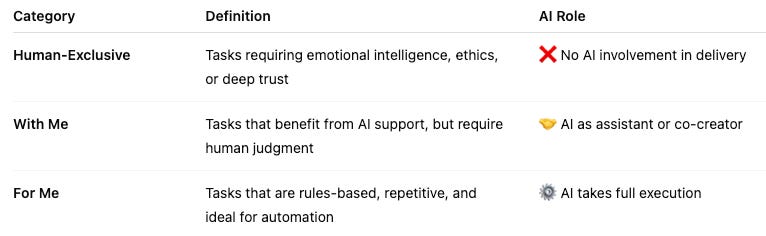
The Prosci AI Integration Framework, which helps classify tasks as:
Human-Exclusive – work that must remain human-led
With Me – work best performed collaboratively with AI
For Me – work that AI can handle independently
The University of California’s AI Principles, which serve as an ethical backbone, emphasizing:
Appropriateness
Transparency
Fairness
Human Values
Privacy
Shared Benefit
Accuracy and Safety
Accountability
Together, these frameworks allow us to implement AI in a way that is strategic, humane, and deeply student-centered.
Core Job Duties of an Academic Adviser
Academic advising is complex, relational, and multi-dimensional. It blends coaching, compliance, cultural awareness, data interpretation, and institutional navigation. These eight core responsibilities represent the breadth of adviser impact—and offer a lens to assess where AI may enhance or endanger their mission.
1. Provide Individual Academic Advising
Advisers meet one-on-one with students to:
Interpret degree requirements, GE patterns, and program pathways
Explore majors and minors aligned with student goals
Navigate academic recovery (e.g., probation, reinstatement)
Support personal and identity-based challenges that impact progress
🔍 AI Insight: This task is high in human complexity. Advising bots may support prep work, but the live conversation requires emotional and cultural fluency.
2. Monitor Academic Progress
Advisers analyze:
Transcripts, GPA trends, and degree audits
Registration patterns and milestones
Holds and academic standing flags
🔍 AI Insight: Ideal for “With Me” AI use—surfacing risks and suggesting interventions, while humans contextualize the data.
3. Support Student Success and Intervention
Includes:
Connecting students with tutoring, basic needs, disability services
Navigating life disruptions (illness, housing, caregiving)
Advocating for policy flexibility
🔍 AI Insight: Risk of harm if automated poorly. Requires trust, equity lens, and context. Use AI only to support—not initiate—interventions.
4. Facilitate Orientation and Onboarding
Advisers:
Explain curriculum and enrollment at orientation
Conduct skill-building workshops
Integrate academic messaging with student affairs, faculty, housing
🔍 AI Insight: Some delivery can be AI-augmented (e.g., chatbots for FAQs), but connection and reassurance still demand human presence.
5. Manage Advising Records and Notes
Tasks include:
Documenting interactions in CRMs or SIS
Updating plans and follow-ups
Ensuring FERPA compliance
🔍 AI Insight: Strong “For Me” candidate. Automate tagging, formatting, and summarizing—while humans retain discretion over sensitive entries.
6. Conduct Student Outreach
Outreach types:
Proactive (e.g., low GPA, undeclared, transfer)
Reactive (missed appointments, risk flags)
Campaigns (graduation prep, registration nudges)
🔍 AI Insight: Great for AI-assisted content creation and segmentation. Human tone and timing must still guide the effort.
7. Collaborate with Faculty and Academic Units
Includes:
Clarifying curriculum pathways
Discussing student needs with instructors
Helping resolve enrollment bottlenecks
🔍 AI Insight: AI can support data prep and bottleneck identification—but human diplomacy remains essential.
8. Contribute to Assessment and Data Review
Responsibilities:
Input into advising-related learning outcomes
Support for student success metrics (retention, GPA, etc.)
Participation in accreditation
🔍 AI Insight: This is fertile ground for AI to automate dashboards, generate insights, and detect patterns—under human interpretation.
Section 3: Using the Prosci AI Integration Framework to Differentiate Human-Exclusive, Augmented, and Automatable Tasks
Using the Prosci AI Integration Framework to Differentiate Human-Exclusive, Augmented, and Automatable Tasks
As institutions integrate AI into advising, the first step is not technical—it’s strategic triage.
What work belongs to humans, what can be enhanced by AI, and what can be automated entirely?
The Prosci AI Integration Framework helps answer that question. It categorizes tasks across three levels of AI suitability:
We now apply this framework to the eight core advising duties:
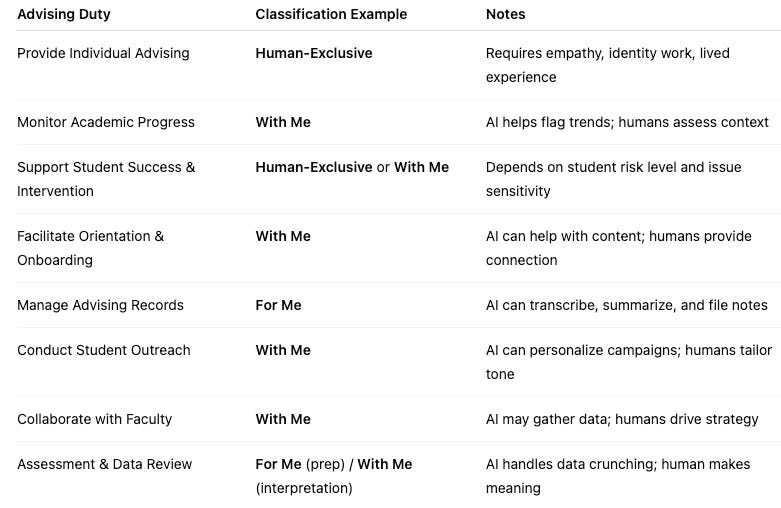
Advising AI Use Cases with Human Safeguards
Monitor Academic Progress
AI can generate early alerts from real-time SIS data and surface risk patterns.
But only humans can interpret whether a low GPA is due to grief, burnout, or systemic exclusion—and respond appropriately.
Conduct Student Outreach
AI can segment students by risk level, personalize outreach messages, and schedule nudges based on registration timelines.
But only humans can sense when a message might retraumatize, misfire culturally, or land as impersonal noise—especially for students already disengaged or distrustful of the institution.
Support Student Success and Intervention
AI can suggest referrals based on keyword analysis in notes or detect behavioral risk signals from platform usage.
But only humans can discern if a student’s silence signals overwhelm, stigma, or systemic harm—and offer compassion, not just compliance.
🎯 How to Use This Framework
Use this matrix in AI governance meetings, advising strategy sessions, or campus planning workshops.
For each duty, ask:
What value does human judgment add?
Where can AI increase capacity without reducing care?
What risks arise from over-automation?
Section 4: Anchoring Advising AI Use in UC Principles and the Prosci Integration Framework
Ethical clarity must precede technical implementation.
Even the best AI tools can harm students if applied without regard for human dignity, trust, and equity. That’s why responsible advising AI must be evaluated through two complementary lenses:
The UC AI Principles, which define what responsible, fair, and human-centered AI use looks like across the institution
The Prosci AI Integration Framework, which helps classify tasks based on their suitability for automation or augmentation
Together, these models allow institutions to answer two critical questions:
Should we apply AI here? (UC Principles)
If so, how? (Prosci Task Fit)
This section breaks down how each of the 8 UC AI Principles applies directly to academic advising and AI.
UC AI Principle 1: Appropriateness
AI should not be used just because it's possible.
In advising, this means asking:
Does this task require cultural sensitivity or emotional judgment?
Would automation harm student trust or well-being?
🛑 Red flag: Automatically emailing dismissal notices may be “efficient,” but ethically inappropriate.
UC AI Principle 2: Transparency
Students and staff must know when AI is involved.
Is the student aware their recommendation was AI-generated?
Can advisers explain how decisions were made?
📣 Tip: Flag AI-assisted actions in student dashboards or messages—“Generated with AI Assistance.”
UC AI Principle 3: Accuracy, Reliability, and Safety
AI systems must work correctly and safely, especially in high-stakes areas.
Do course suggestions follow catalog logic?
Are risk flags updated in real time?
Is financial aid information verified?
🚨 Impact: A flawed algorithm can derail degree plans or funding eligibility.
UC AI Principle 4: Fairness and Non-Discrimination
AI should not widen equity gaps.
Are students of color flagged more often for “risk”?
Are alternative paths (e.g., part-time, transfers) treated as “lesser”?
Is there bias in which students get nudged?
⚖️ Action: Audit AI tools for disparate impact across race, disability, first-gen status, and more.
UC AI Principle 5: Privacy and Security
Advising data is sensitive and protected.
Are generative tools connected to open web APIs?
Is FERPA-protected data kept internal and encrypted?
Can AI infer personal circumstances from indirect data?
🔒 Reminder: Academic struggles, mental health issues, and financial hardship are not just datapoints—they’re deeply human disclosures.
UC AI Principle 6: Human Values
AI must uphold dignity, agency, and relationship.
Does the student feel seen or sorted?
Is the adviser still present in the process?
Are we building trust or simply routing tasks?
❤️ Litmus Test: Would this tool strengthen my relationship with the student—or replace it?
UC AI Principle 7: Shared Benefit and Prosperity
AI should uplift all students—not just those who are easy to serve or tech-savvy.
Are multilingual or disabled students able to access the same insights?
Are first-gen students receiving relevant nudges?
📈 Design Principle: Equity must be baked in—not retrofitted.
UC AI Principle 8: Accountability
Institutions must remain responsible for AI decisions and errors.
Can students challenge an AI recommendation?
Do staff know how to report harm?
Are systems regularly audited?
🧭 Rule: Every AI-influenced action should be reviewable—and reversible—by a human.
Closing Insight
Ethical AI in advising is not a compliance checkbox—it is a governance obligation. These principles must be embedded in procurement, implementation, training, and evaluation. When applied well, they protect not only our students but also the soul of the advising profession.
Section 5: Situating Advising in the Campus AI Ecosystem
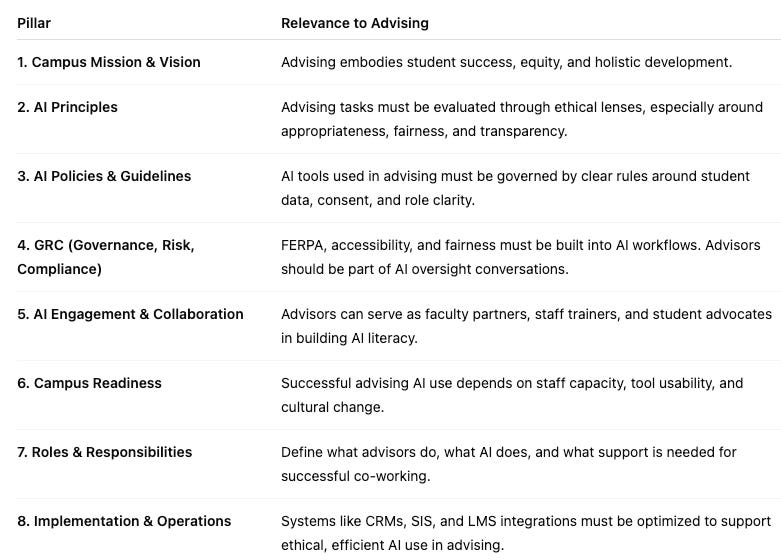
To ensure AI use in academic advising is not fragmented or reactive, it must be embedded within a broader, mission-aligned AI strategy. That’s the purpose of the Campus AI Framework—a system-wide structure that guides responsible adoption, use, and governance of AI across the institution.
Advising is not peripheral to this framework. It is a frontline test case for whether we can implement AI in a way that scales without losing trust, care, or equity.
Advising and the Campus AI Framework
The Campus AI Framework rests on eight pillars. Advising intersects with many of them:
Advising Within the Teaching & Learning Domain
Within the Campus AI Framework’s broader architecture, academic advising lives in the Teaching & Learning Domain—but its reach extends far beyond scheduling and degree progress.
Advisers are educators, sensemakers, and system navigators. AI that supports them must be held to that same interdisciplinary, high-impact standard.
AI in advising touches:
Orientation and onboarding
Retention and success analytics
Equity interventions
LMS pathways and progress nudges
Student development and self-authorship
In this sense, advising is a mirror and model for how AI can serve human flourishing—if designed with care.
Anchoring in ERAT: Ethical, Responsible, Accountable, Trustworthy
All AI use in advising must pass the ERAT test:
Ethical – Does this respect the dignity and agency of every student?
Responsible – Is there oversight, training, and policy alignment?
Accountable – Can errors be traced, explained, and corrected?
Trustworthy – Will students and staff feel safe using it?
ERAT is not a filter to apply after AI is deployed—it is a foundation to build from the very beginning.
Institutional Imperative
Advising is one of the most emotionally complex, legally sensitive, and equity-critical functions on campus.
That’s why its AI integration must be:
Governed by ethics and transparency
Supported by infrastructure and policy
Shaped by those who understand students best—advisers themselves
Section 6: Conclusion and Final Reflection
Advising is not just an administrative function—it is the emotional, academic, and ethical heartbeat of student success.
It’s where life plans are rewritten. Where institutional policy is translated into personal meaning. Where one conversation can determine whether a student stays, leaves, thrives, or disappears.
And that is precisely why AI must serve advising—never replace it.
In a time of shrinking bandwidth and growing complexity, artificial intelligence offers powerful possibilities:
To offload the routine
To amplify the essential
To extend the reach of care
But only if guided by values.
Protect. Partner. Perform.
This article offered three tools to help you implement AI intentionally in advising:
Protect: Use the UC AI Principles to safeguard dignity, trust, and equity.
Partner: Use the Prosci Integration Framework to determine where AI can assist—without replacing humanity.
Perform: Embed AI within your Campus AI Framework to ensure responsible scaling, alignment, and oversight.
These are not just tools for advising—they are templates for ethical institutional transformation.
The Risk of Getting It Wrong
If we treat advising as a task to optimize rather than a relationship to uphold, we risk:
Widening equity gaps
Eroding student trust
Undermining developmental learning
AI must not become a shortcut to scale. It must be a commitment to deepen impact.
Final Thought
The goal is not to serve more students with less humanity—
It is to serve every student with greater intentionality,
supported by tools that reflect our highest values,
not just our fastest capabilities.
Let advising lead the way.
Not just in how we adopt AI—but in how we remain human, together.
References and Other Relevant Academic Advising Sources
Have thoughts or want to collaborate? Email me at joepsabado@gmail.com, connect with me on LinkedIn, or visitCampusAIExchange.com for more resources on responsible AI adoption in higher education.
Note: The perspectives shared are personal and do not reflect official positions of my employer.